

Spring is the best time to install ceiling insulation for most Australian homes. Ceiling insulation slows heat moving through your ceiling. It is laid in the roof space, the gap between your ceiling and roof. In spring, the roof space is milder than in summer, so the work is safer. The insulation is also ready before the first heatwave. It works in every season.
Key Takeaways
- Ceiling insulation is rated by R-value, a measure of resistance to heat flow. Higher is better, and the right value depends on your climate zone under the National Construction Code (NCC).
- Spring (September to November) sits between winter and summer, so roof spaces are milder, and installers can work more safely.
- Insulation fitted in spring is already slowing heat flow through your ceiling when hot weather arrives.
- Spring leaves time to check IC-rated and other downlights, wiring, roof ventilation and existing insulation, and to confirm the work follows AS 3999.
- Autumn suits homes that struggle most with winter cold. A safe install in any season is better than none.
Why Spring Is a Good Time to Install Ceiling Insulation
Spring works well because three things line up. Roof space conditions are milder, you have a clear run before summer, and there is time to prepare. In Australia, spring runs from September to November.
Milder roof spaces make the work safer
In summer, heat builds up in the roof space, and it can become far hotter than the air outside. Work safety guidance for insulation installers lists heat and humidity as a risk of heat stress. It also advises against doing installation work in the hottest part of the day.
Spring roof spaces are milder than in peak summer, which lowers that risk. Even so, installers still prefer to start early, when the roof space is coolest.
The insulation is working before summer arrives
Ceiling insulation slows the flow of heat through your ceiling. In summer, it helps keep the sun’s heat out. In winter, it helps keep warmth in. Installing in spring means this protection is in place before the first hot spell, not after it.
Spring leaves time for safety checks
A good insulation job starts with checks of your downlights, wiring, roof ventilation and existing insulation. A check can find a problem, such as a downlight that needs to be replaced. Spring gives you time to fix it before the hot weather.
Can You Install Insulation in Summer or Winter?
Yes. Insulation can be installed in any season. The season changes how safe and comfortable the work is, not whether the insulation works afterwards.
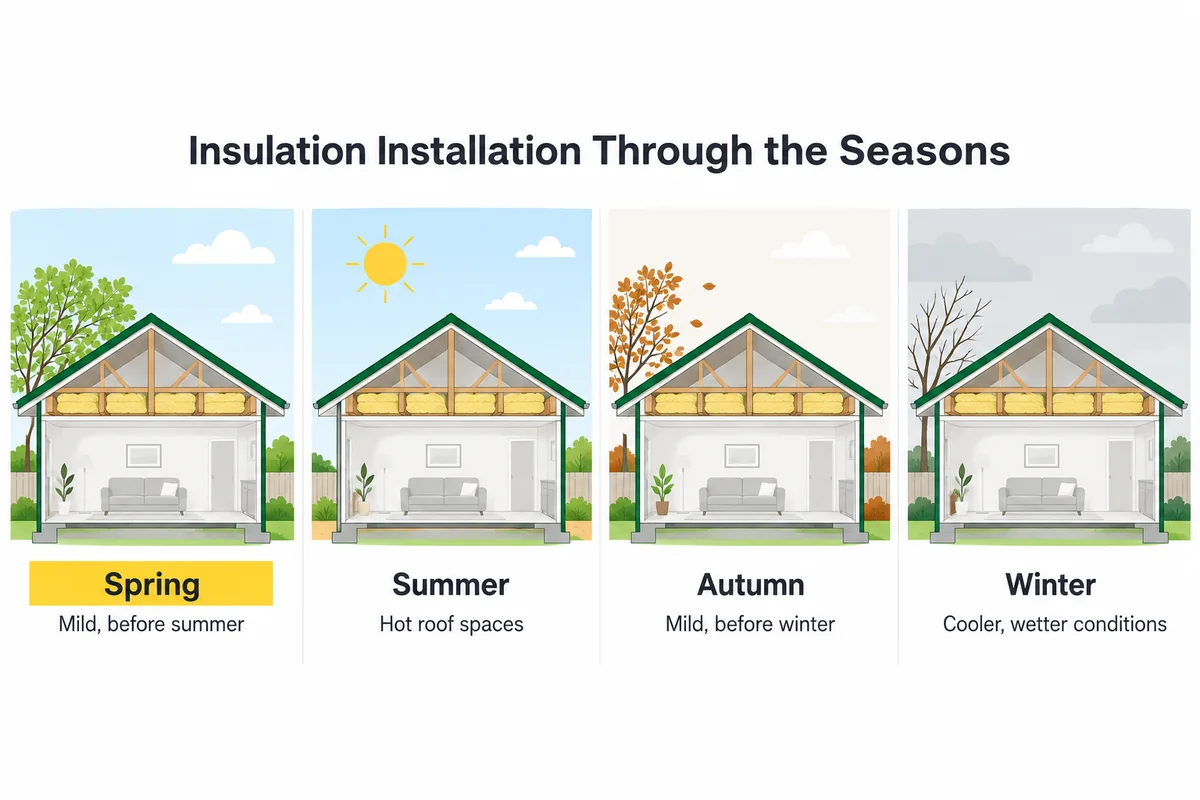
The table below shows what each season means for the roof space and for your decision.
| Season | Roof space conditions | Main advantage | Main limit |
|---|---|---|---|
| Spring (Sep–Nov) | Mild, before peak heat | Safer work, ready before summer | Seasons vary by region |
| Summer (Dec–Feb) | Can become very hot | Fixes a heat problem straight away | Higher heat stress risk, so work is limited to cooler hours |
| Autumn (Mar–May) | Mild, after summer | Ready before winter cold | You live through summer heat first |
| Winter (Jun–Aug) | Cooler air | Fixes a cold problem straight away | Cold, wet days can make roof access harder |
Should you insulate before summer or winter?
Choose the season that matches your bigger problem. If your home is too hot in summer, spring is ideal. If it is too cold in winter, autumn is just as good. Ceiling insulation helps in both seasons, so most homes gain either way.
If you have either problem right now, do not wait for the perfect season. A safe install today beats another year of discomfort.
Does insulation work better in one season?
No. Insulation resists heat flow all year. Its R-value, which is a measure of that resistance, does not change with the calendar. What changes is how much you notice it, because the hottest and coldest days show the difference most.
Does your climate change the answer?
Yes. Spring is a mild season in much of southern Australia. In the tropical north, the year is better described as wet and dry seasons. Ask a local installer which months suit your area.
How Ceiling Insulation Works and What R-Value Means
Ceiling insulation slows heat as it moves through your ceiling. That reduces heat gain in summer and heat loss in winter, so your heater and air conditioner run less often.
R-value measures how well a material resists heat flow. A higher R-value means better insulating ability. It depends on the material and its thickness. Squashing insulation lowers its R-value, so batts should fit snugly without being compressed. Declared R-values are based on tests under AS/NZS 4859.1. This is the Australian and New Zealand standard for materials used to insulate buildings.
There are two main groups of ceiling insulation:
- Bulk insulation slows heat flow through its thickness. It includes glasswool, polyester and wool batts, and loose-fill materials such as cellulose fibre. Loose-fill is usually installed by professionals.
- Reflective insulation is a foil-backed material that reflects radiant heat, which is heat that travels as rays. It is not covered by AS 3999, the installation standard for bulk insulation.
You can view the ceiling insulation products that OZ Homes Insulation supplies to compare the options.
Will insulation lower your energy bills?
It can reduce how much you need heating and cooling. The savings depend on your home, your existing insulation and how you use your heater and air conditioner. No installer can honestly promise a set amount without inspecting your home. OZ Homes Insulation looks at this question in more detail in how much insulation can save on energy bills.
What to Check Before Insulation Goes In
Check four things first: downlights, wiring, roof ventilation and existing insulation. These checks keep the job safe, and spring gives you time to complete them without rushing.
Downlights and wiring
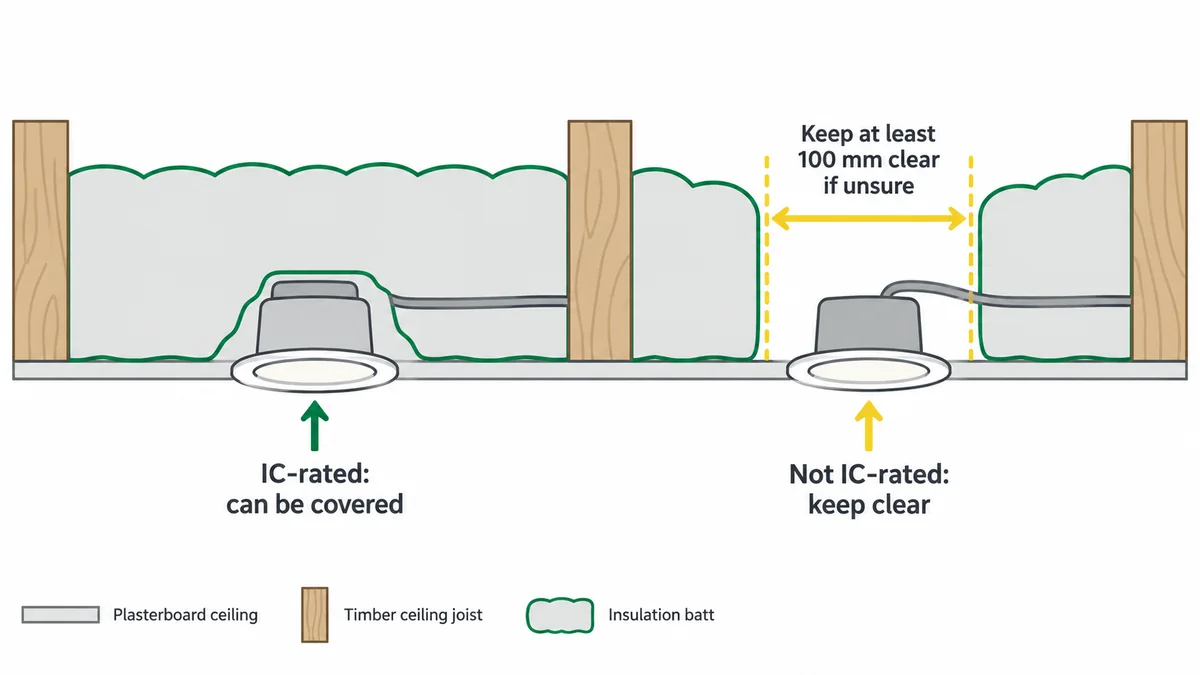
Not every downlight can be covered by insulation. The rating on the fitting tells you what is safe. A licensed electrician can confirm this and check the wiring before work starts.
| Downlight rating | What it means for insulation |
|---|---|
| IC or IC-4 | Can be covered by insulation. Some makers say their fittings are not suitable for loose-fill. |
| CA | Can touch insulation but must not be covered. |
| Not IC-rated | Needs a clear gap from insulation. If unsure, keep at least 100 mm clear. |
Tell your installer about anything else in the ceiling, such as exhaust fans, gas heater flues, security alarms and transformers. Each one may need extra clearance or an electrical check.
Roof ventilation and moisture
A roof space with poor ventilation lets heat and moisture build up. Insulation does not replace ventilation. Ask your installer how your roof is ventilated and whether moisture needs managing, especially in cooler climate zones.
Existing insulation
Existing insulation may be good, worn out or in the wrong place. Insulation also wears down over time. An installer will check its type, thickness, age and condition. Dry, undamaged insulation can often be topped up. Wet, dirty or damaged insulation may need replacing. OZ Homes Insulation also offers insulation removal for old or damaged material.
Do not climb into the roof space to check it yourself. It can be hot, hard to move in and home to live wiring. The plasterboard between the joists will not hold your weight. A certified installer can inspect the ceiling and estimate its R-value.
Standards and R-Values: What the Rules Say
Three sets of rules matter for ceiling insulation: the National Construction Code, AS 3999 and AS/NZS 4859.1. The table shows what each one covers.
| Rule | What it covers |
|---|---|
| National Construction Code (NCC) | Sets minimum total R-values for roofs and ceilings in new homes and additions. The values depend on the climate zone, from 1 to 8. Your state decides which edition applies and may vary it. |
| AS 3999:2015 | Sets how bulk insulation is installed in new homes and retrofits, including electrical safety and work health and safety guidance. It does not cover foamed-in-place or reflective foil laminate insulation. |
| AS/NZS 4859.1 | Sets criteria for insulation materials. It is the basis for declared R-values. |
What R-value do you need? It depends on your climate zone, roof type and existing insulation. The NCC minimums apply to new homes, but they are a useful guide for upgrades. Ask your installer which R-value suits your home and get it in writing.
AS 3999 also includes an installation statement. This is a record of the completed insulation work. Ask for one when the job is finished.
Is Spring the Right Time for Your Home?
Spring is a strong choice when your home shows signs of poor insulation and summer is close. Look for these signs:
- Rooms, especially upstairs, are too hot in summer.
- The house stays cold in winter even with the heater on.
- Heating and cooling bills are high.
- The home is older and has little or no insulation.
- Existing insulation is sagging, uneven, damaged or wet.
OZ Homes Insulation has a page for existing homeowners who want to improve comfort and cut energy use. Renting? Talk to your landlord about installing or topping up insulation.
How to Choose an Installer and Get a Quote
Choose an installer who inspects your roof space, explains their choices in writing and works to AS 3999. Licensing rules differ between states, so confirm that your installer holds the licence or registration your state requires.
Ask every installer these questions:
- Will you inspect my roof space and my existing insulation?
- Will an electrician check my downlights and wiring?
- Which material and R-value do you recommend, and why?
- Will you give me an installation statement when the job is done?
- Is everything in the quote written down, including preparation and clean-up?
OZ Homes Insulation provides insulation installation for homes, and you can ask the team these same questions. Cost depends on several things. These include your roof area, the material and R-value, and how easy the roof space is to reach. Removing old insulation or doing electrical work adds to the cost. This article gives no prices because they vary by home and region. Rebates and discount programs also differ by state and change over time. Check your state government’s energy website for current rules before you book.
Plan Your Insulation Before Summer Heat Arrives
Spring gives you a mild, safer window to install ceiling insulation and enough time to fix any problems before summer. Start with a roof space inspection, check your downlights and wiring, and confirm the R-value in writing.
Frequently Asked Questions
Can I add new insulation over existing insulation?
Often, yes, if the old insulation is dry, clean and in good condition. An installer should check it first. Damaged or wet insulation usually needs to be replaced.
Which type of ceiling insulation should I choose?
It depends on your roof, climate zone and how easy the roof space is to reach. Batts suit open, accessible ceilings. Loose-fill can suit tight spaces. Your installer should explain why they recommend one type over another.
How long does ceiling insulation last?
There is no single lifespan. Insulation wears down over time, and moisture, damage or disturbance can cut its performance. Check it every few years, and ask an installer to inspect it if your home feels less comfortable than before.
Can insulation cause condensation in the roof space?
It can contribute when a roof space has poor ventilation or moisture problems. Good ventilation and the right materials for your climate zone help manage this. Ask your installer to check your roof space before the work.
Can I install insulation myself?
Some homeowners do, but it carries real risks. Roof spaces are hot, hard to move in and can hold live wiring and downlights. You must step only on the joists. Loose-fill is usually installed by professionals. A professional can also give you an installation statement.
Get Your Home Ready Before Summer
Inspection, removal, supply and installation from one Victorian insulation team.