Insulation saves money by cutting the heating and cooling energy a home needs. CSIRO puts that reduction at 45 per cent or more for a home going from uninsulated to well insulated. In Victoria, the state government estimates more than $400 a year for homes with no ceiling insulation or very little. The savings depend almost entirely on what your home starts with, so the honest answer is a range and a method, not a single number.
Key Takeaways
- The less insulation you have now, the more you can save.
- CSIRO says going from no insulation to a well-insulated home can cut heating and cooling costs by 45 per cent or more.
- Heating accounts for about 43 per cent of energy costs in an average Victorian home.
- Installed ceiling insulation is roughly $1,800 to $2,800, while the Victorian Government uses an average of about $3,000.
- From 1 October 2026, eligible Victorian homes can receive a VEU discount of up to $1,482.
- Payback is the installed cost divided by the yearly saving.
- DIY ceiling batts do not qualify for the VEU discount.
This guide covers what insulation saves, what it costs and how fast it pays for itself. It also explains how the Victorian discount changes the maths. Oz Homes Insulation supplies and installs insulation across Victoria and helps owners of established Victorian homes work out what their roof space needs.
What Are the Real Numbers?
Every figure below comes from a government or research source. The right-hand column is the one most articles leave out.
| Figure | What It Means | Source and Condition |
|---|---|---|
| 45 per cent or more | Reduction in heating and cooling costs | CSIRO, for a home going from no insulation to well insulated |
| More than $400 a year | Average bill saving for a Victorian home | Victorian Government, for homes with no or low ceiling insulation |
| About 43 per cent | Share of energy costs spent on heating in an average Victorian home | Residential Baseline Study 2021, published by Sustainability Victoria |
| 25 to 35 per cent | Share of heat lost or gained through the ceiling | Victorian Residential Efficiency Scorecard |
| 15 per cent | Heating and cooling reduction from wall insulation | CSIRO |
| Over $850 a year | Estimated health cost savings from a ceiling upgrade | Solar Victoria, average estimate |
| Almost 60 per cent | Victorian homes with no ceiling insulation or under-insulated | Victorian Government |
The number that matters is your starting point Most pages quote the 45 per cent figure without the condition attached. CSIRO applies it to a home going from no insulation to well insulated. A home with tired R2.5 batts is already capturing much of that saving, so topping up returns a fraction of it.
How Much Will Your Home Save?
Your likely saving depends on how much working insulation is in your ceiling right now. Use the table below to find your starting point, then confirm it with a roof space inspection.
The Victorian Government’s estimate of more than $400 a year covers homes that are uninsulated or under-insulated, so it applies to the first three rows rather than only the first.
| Your Starting Point | Likely Saving | What to Do |
|---|---|---|
| No ceiling insulation | Largest available saving. The CSIRO 45 per cent figure applies to this group. | Install to at least R3.5 and check VEU eligibility |
| Thin, squashed or patchy insulation | Partial saving. You already capture some benefit, so the gain comes from restoring full, even coverage. | Top up, or remove and replace if damaged. Check VEU eligibility if below R2.0 |
| Damaged, damp or pest affected | Reduced saving. Sustainability Victoria gave the example of a 150 mm batt losing 25 per cent of its R value when squeezed into a 90 mm space. | Remove first, then install new insulation |
| Already at R3.5 or above and in good condition | Small saving from the ceiling. Look to walls, floors and draughts instead. | Spend elsewhere, or seal gaps first |
How Much Does Ceiling Insulation Cost in Melbourne?
Installed ceiling insulation costs roughly $1,800 to $2,800 according to CSIRO, and the Victorian Government uses an average of about $3,000 when it describes the VEU discount. Your quote depends on ceiling area, roof access, the R value you choose and whether old insulation must be removed first.
| Option | Typical Cost | Notes |
|---|---|---|
| Supply only, Pink Batts glasswool ceiling | From $6.95 per square metre | Oz Homes online shop, 15 September 2026 |
| Supply only, Knauf Earthwool ceiling | From $7.04 per square metre | Oz Homes online shop, 15 September 2026 |
| Supply only, Bradford Gold ceiling | From $7.24 per square metre | Oz Homes online shop, 15 September 2026 |
| Supply only, polyester ceiling batts | From $10.00 per square metre | Bradford Polymax, Oz Homes online shop |
| Supply and install, whole ceiling | About $1,800 to $2,800 | CSIRO estimate, varies house to house |
| Supply and install, Victorian average | About $3,000 | Figure used by the Victorian Government for the VEU discount |
| Insulation removal first | Added to the job, quoted separately | Needed when insulation is damp, dusty or pest-affected |
Tip: price per square metre, not per bag. Insulation is sold by coverage, so multiply your ceiling area by the price per square metre. A 150 square metre ceiling at $6.95 per square metre is about $1,050 in materials, before delivery and before any installation cost.
Oz Homes Insulation sells ceiling insulation by brand and R value for collection from the Ravenhall warehouse or delivery, and also offers professional installation for people who would rather not work in a roof space.
How Long Does Insulation Take to Pay for Itself?
Payback is the installed cost divided by the yearly saving. For a Victorian home with no ceiling insulation, using the government average cost of $3,000 and the government average saving of $400 a year, the job pays for itself in about 7.5 years. With the VEU discount applied, that falls to about 3.8 years.
The Maths, Step by Step
- Start with the installed cost. The Victorian Government uses about $3,000 for an average ceiling insulation install.
- Subtract the discount. The VEU discount of up to $1,482 leaves about $1,518 to pay.
- Divide by the yearly saving. $1,518 divided by $400 a year is about 3.8 years.
- Compare with no discount. $3,000 divided by $400 a year is 7.5 years.
- Then keep counting. Insulation keeps working after payback. The savings continue every year the material stays dry and uncompressed.
Two things change this figure A home that already has insulation saves less each year, so payback stretches out. And the $400 estimate is an average across Victorian homes, not a quote for your house. Treat the method as the useful part, not the number.
Can You Get a Discount on Ceiling Insulation in Victoria?
Yes. From 1 October 2026, eligible Victorian homes with uninsulated or under-insulated ceilings can receive a Victorian Energy Upgrades discount of up to $1,482. The Victorian Government expects it to cut the average install cost by roughly 30 to 50 per cent depending on home size.
The main conditions are:
- Your ceiling must be uninsulated, or its existing uncompressed insulation must average below R2.0.
- Only Energy Efficiency Council certified installers can carry out the upgrade.
- Foil-faced, cellulose and loose-fill insulation are excluded from approved products.
- An electrical safety check is required before installation, and some downlights may need work first.
- Stage 1 from 14 April 2026 covered public and community housing only. Stage 2 opens it to all eligible homes.
Solar Victoria also estimates over $850 a year in avoided health costs on average, on top of the energy savings. The discount is applied by the installer rather than claimed back, so ask any installer to confirm their VEU accreditation in writing before you book.
Why the Ceiling Saves the Most
The ceiling is the first place to spend, which is why every figure above is a ceiling figure.
The ceiling returns the most because it loses the most heat. Warm air rises. The Victorian Residential Efficiency Scorecard program puts ceiling losses at 25 to 35 per cent of a home’s heat loss or gain, ahead of walls, floors, windows and gaps.
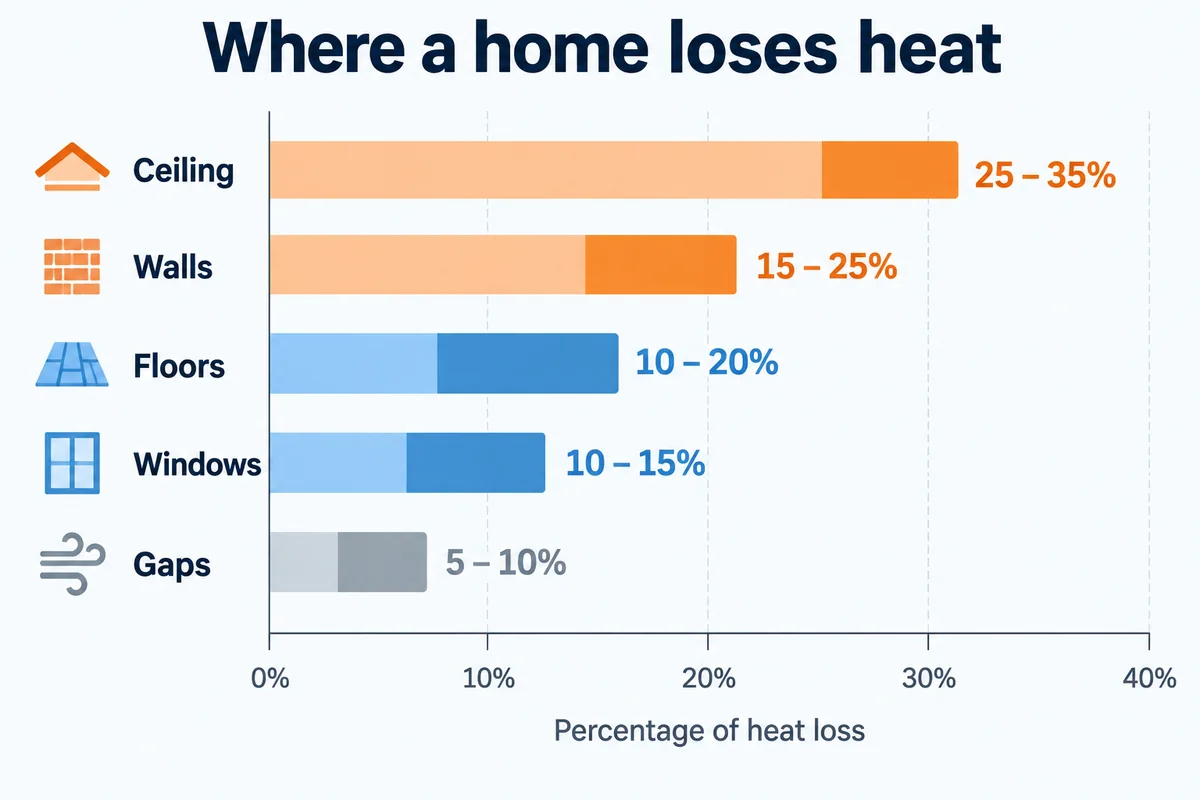
This is also why the fix order matters. CSIRO recommends ceiling insulation first, then walls and floors where possible. Wall insulation can cut heating and cooling costs by about 15 per cent. It is far harder to retrofit once a home is built. Our guide to ceiling insulation and winter heat loss explains how the ceiling layer works.
What Changes the Savings You Actually Get?
Two homes can install the same batts and save different amounts. These are the factors that move the number.
Installation Quality
Gaps, compressed sections and batts pushed aside all reduce the achieved savings, because heat escapes through the uncovered area. Correct installation is what protects the R value you paid for. Work should follow Australian Standard AS 3999 and the electrical wiring rules, AS/NZS 3000.
R Value Chosen
A higher R value resists more heat flow and costs more. For Victoria, R3.5 is the usual minimum recommendation for ceilings, with R5.0 suggested for alpine areas. Going far above the recommendation returns less for each extra dollar.
How You Heat Your Home
Insulation cuts the energy needed, but the dollar value of that energy depends on your fuel and your tariff. The same reduction in heating demand is worth a different amount on gas than on electricity.
Whether Removal Is Needed
Damp, dusty or pest-affected insulation usually has to come out before new material goes in, which adds to the project cost and stretches the payback. Oz Homes can remove old insulation and install the replacement as one job.
The Return That Does Not Show on the Bill
Energy savings are only part of the return. Insulation also delivers benefits that never appear as a dollar figure on a statement.
- Comfort. Rooms hold their temperature longer, and cold spots in hallways and back rooms even out.
- Health. Solar Victoria estimates over $850 a year in avoided health costs on average from a ceiling upgrade.
- Condensation control. A better insulated ceiling reduces the cold surfaces where moisture collects.
- Quieter rooms. Bulk insulation reduces some noise transfer as well as heat transfer.
- Lower emissions. Less heating and cooling energy means a smaller carbon footprint.
- Longevity. Insulation keeps performing for decades when it stays dry and uncompressed, so the savings repeat long after payback.
Work Out Your Number, Not the Average
Bottom line The headline savings belong to homes starting from nothing. Find out what is in your roof space, get the installed cost for your ceiling area, then divide by a realistic yearly saving. That is your payback, and it is the only number worth acting on.
Oz Homes Insulation has supplied and installed insulation across Melbourne and much of regional Victoria since 2016, from its warehouse in Ravenhall. The team can inspect your roof space, recommend an R value, quote removal and installation together, and supply materials if you would rather do the work yourself.
Get Your Numbers Before October
Inspection, removal, supply and installation from one Victorian insulation team.
Request a Free Quote ☎ 1300 383 802
Frequently Asked Questions
Does insulation really lower your electricity bill?
Yes, when the home needs less heating and cooling. CSIRO puts the reduction at 45 per cent or more on heating and cooling costs for a home going from uninsulated to well insulated. It reduces the heating and cooling part of the bill, not the whole bill, so appliances, hot water and lighting are unaffected.
Is DIY insulation cheaper than professional installation?
Supply only is cheaper in materials, starting from $6.95 per square metre for ceiling batts. It does not qualify for the VEU discount, because only Energy Efficiency Council certified installers can deliver those upgrades. A discounted professional job can therefore cost less than a full-price DIY one.
Does insulation save money in summer as well?
Yes. Insulation slows heat moving in either direction, so it reduces heat gain through the ceiling in summer as well as heat loss in winter. The Scorecard heat loss ranges are quoted as heat loss or gain for that reason.
Is it worth topping up insulation I already have?
Topping up is worthwhile when the existing layer is thin, uneven or below the R3.5 recommendation. The saving is smaller than for an uninsulated ceiling, because you are already capturing part of the benefit. A roof space inspection will show whether a top-up or a full replacement makes sense.
How much does it cost to remove old insulation first?
Removal is quoted separately because it depends on the roof space size, access and the condition of the material. It is usually needed when insulation is damp, very dusty, pest-affected, or mixed with debris. Ask for removal and installation to be priced together so you can see the full project cost.