
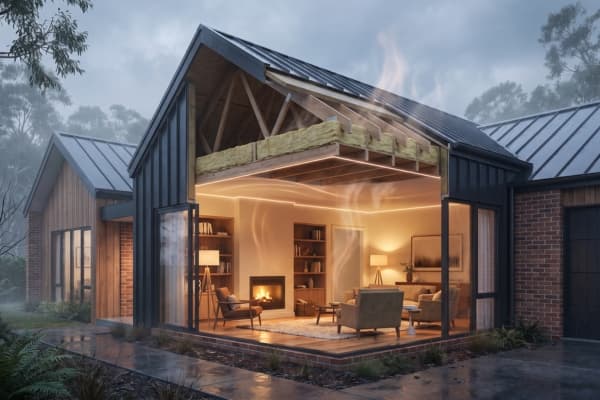
When a Victorian winter sets in, the difference between a home that’s warm and one that costs a fortune to heat usually comes down to one thing, ceiling insulation. Heat rises, and if the warm air your heater works so hard to create is slipping straight out through the roof, you’re paying for comfort you never actually feel.
Up to 35% of a home’s heat can be lost through the ceiling making it the single biggest weak point in a typical home’s thermal envelope. The good news is that it’s also the easiest and most cost-effective area to fix.
In this guide we’ll cover how ceiling insulation works, the main types and brands, the R-values you need for a Victorian climate, what it costs, whether to DIY or hire a professional, and the warning signs that your existing insulation needs replacing. By the end you’ll know exactly what to ask for when you book a quote.
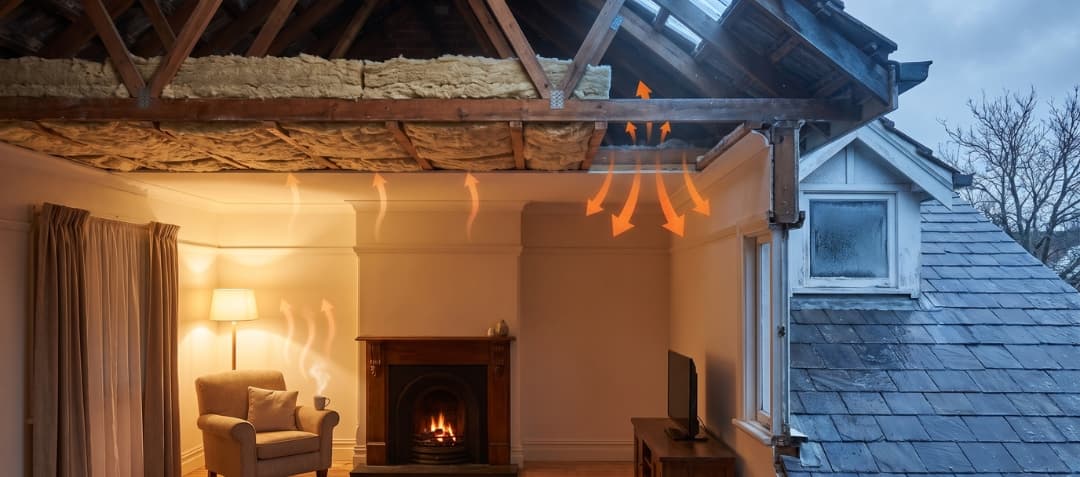
Physics isn’t on your side in winter. Warm air is less dense, so it constantly rises toward the ceiling. In a home with no ceiling insulation or old, compressed, sagging batts that have lost their performance, that heat passes straight through the plasterboard, into the roof space, and out through the roof.
The result is a heater that runs non-stop while rooms still feel cold, uneven temperatures from room to room, and energy bills that climb every winter. Because the roof space is the largest uninterrupted surface between your living areas and the outside, it has an outsized effect on how warm and how affordable your home is.
Insulating the ceiling tackles the problem at its biggest source. It’s why insulation specialists almost always recommend starting at the ceiling before walls or floors, you get the most comfort and the biggest bill reduction for your dollar.
Ceiling insulation works by slowing down the transfer of heat. Insulation batts are full of millions of tiny pockets of trapped, still air, and still air is a poor conductor of heat. That trapped air creates thermal resistance, a barrier that keeps your heated air inside in winter, and keeps unwanted heat out in summer.
That’s the year-round payoff in winter your ceiling insulation holds warmth in, and in summer it stops your roof space, which can exceed 50°C from radiating heat down into your living areas. One upgrade, comfort in both seasons.
Made from polyester fibre (often part-recycled), these are non-irritant and allergy-friendly, a great choice for asthma-sensitive households or anyone planning a DIY install who wants to avoid itch and fibres. They’re durable and don’t shed, though they often sit at a slightly higher price point than glasswool for the same R-value.
A higher-density option made from spun mineral fibre. Rockwool delivers excellent fire resistance and acoustic performance, making it popular where noise reduction or extra fire safety matters. It costs more than glasswool but punches above its weight on performance.
Type | Thermal performance | Relative cost | Best for | Irritant? |
Glasswool batts | High | $ | Most homes; best value retrofit | Mild (wear PPE) |
Polyester batts | High | $$ | Allergy/asthma homes, DIY | No |
Rockwool / mineral wool | High (dense) | $$$ | Fire + acoustic priority | Low – mild |
Reflective foil | Low – medium (radiant) | $ | Supplementary / specific builds | No |
Blow-in / loose-fill | Medium – high | $$ | Hard-to-access cavities | Varies |
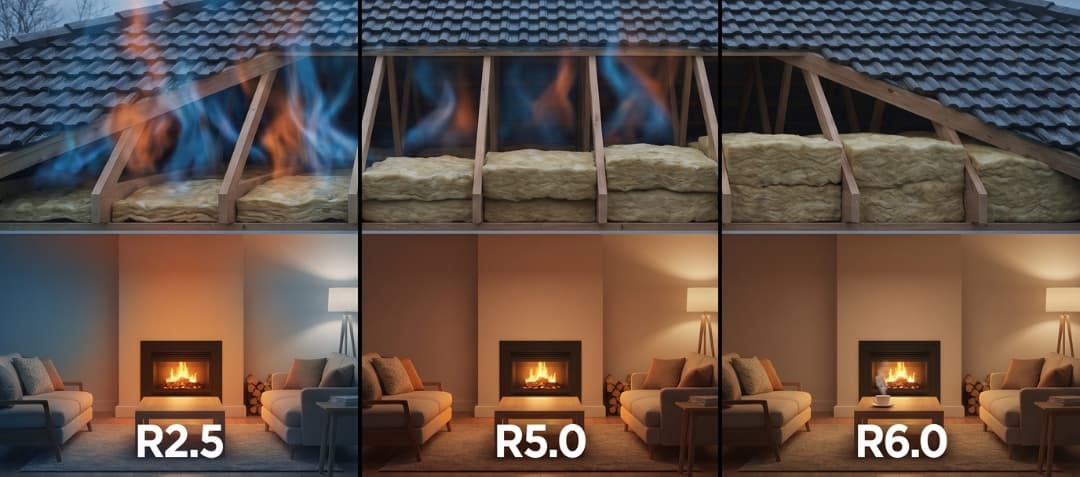
The R-value measures thermal resistance, how well the insulation resists heat flow. The simple rule: the higher the R-value, the better the insulation performs.An R6.0 batt holds heat in far more effectively than an R2.5 batt.
For Victorian and southern-climate homes, the cold-winter climate means you want a high ceiling R-value. Current guidance points to a target of around R5.0 – R6.0 for ceilings in this region to meet modern energy-efficiency standards and get the most comfort.
Ceiling R-value | Typical use |
R2.5 | Older minimum / warmer climates; usually too low for a Victorian winter |
R3.5 | Entry-level upgrade; better than nothing |
R4.0 | Mid-range performance |
R5.0 | Strong performer; common modern ceiling specification |
R6.0 | High performance; recommended for cold Victorian winters |
R7.0 | Premium / maximum thermal resistance |
As an indicative guide, ceiling insulation batts start from around $8 – $12/m² supply only, with supply-and-install commonly in the range of $15 -$30/m². For a typical 3 – 4 bedroom Melbourne home, that usually works out to a few thousand dollars (around $2,000 – $3500) all up an upgrade that often pays for itself through energy savings within a few years.
It’s also worth checking the Victorian Energy Upgrades (VEU) program eligible households may be able to access a discount or rebate on ceiling insulation. Our team can tell you whether your home qualifies when we quote.
For a confident, hands-on homeowner, installing ceiling batts can be a DIY job, but there are real risks to weigh up.
Difficult roof access, removing or replacing old or damaged insulation, guaranteed no-gap coverage, and navigating rebates and compliance. A professional install means it’s done once, done safely, and done to standard with the full performance you paid for.
Thinking about upgrading? Our team handles supply and installation across Melbourne and regional Victoria and if your old insulation needs to go first, we remove it properly. Learn about our insulation removal service.
If you’re seeing any of these, topping up over the top of damaged insulation won’t fix the problem, the old material often needs to come out first. Read more in our guide on the signs your old insulation needs removing, or go straight to our insulation removal service to book an inspection.
Of every upgrade you can make to a home, ceiling insulation delivers the most comfort and the biggest bill savings for the least cost. It tackles winter heat loss at its single biggest source and keeps you cooler in summer as a bonus. If your insulation is old, sagging, damaged or simply missing, this winter is the time to fix it.
OZ Homes Insulation supplies and installs quality ceiling insulation across Melbourne and regional Victoria and removes old, damaged insulation properly before we do.
🇦🇺 Australian-owned
⭐ 4.9/5 from 600+ Google reviews
🏆 #1 Best Rated 2025
💰 We’ll beat any written quote – plus $100 off
📞 **Call 1300 383 802 for a FREE measure & quote or request your quote online.
Quality batts can last several decades if kept dry and undisturbed. However, water damage, pests, compression and renovations can shorten that lifespan, which is when replacement (rather than topping up) becomes the smart move.
Quick Quote
Our team are well placed to advise you on the right insulation products for your construction project.
Our team are well placed to advise you on the right insulation products for your construction project.